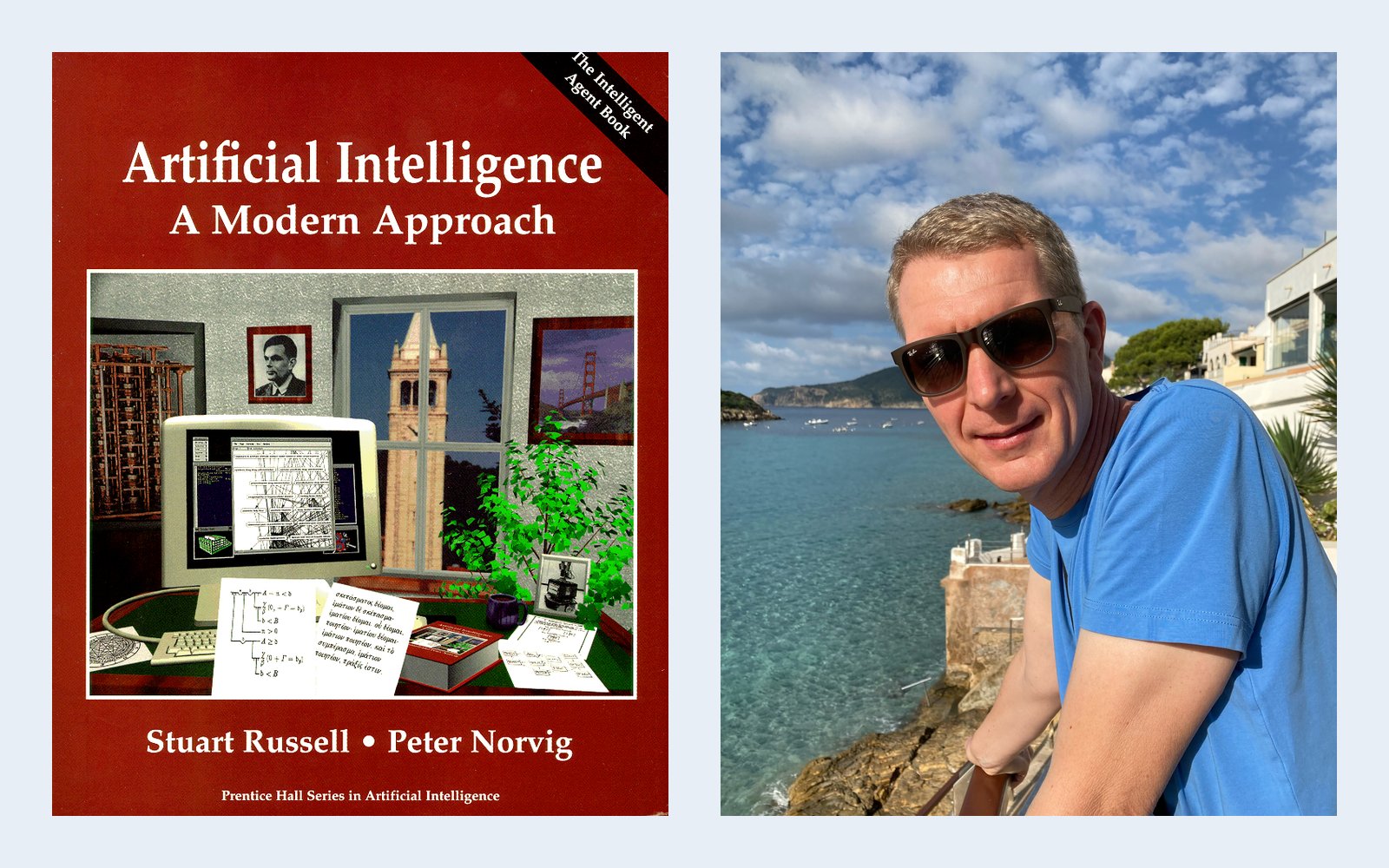
When I studied computer science in the mid-1990s, artificial intelligence was one of the subjects that fascinated me most. We learned the fundamentals, the state of research and the applications of the day. Our textbook was the then brand-new "Artificial Intelligence: A Modern Approach" by Stuart Russell and Peter Norvig, which soon became the standard work of the field. It covered a wide range: searching for solutions, logical deduction, planning, reasoning under uncertainty, and neural networks and how to train them. Interestingly, the book described AI as the study of intelligent agents – systems that perceive their environment and act on their own. Thirty years later, that idea is back at the centre of it all. At the end of my studies, my conclusion was clear: AI is exciting, but the technology is far from ready for real industrial use. Outside the research labs, there were very few applications.
That conclusion held for a long time. Over the years I kept an eye on what AI achieved in the wider software industry, but it was never a topic we worked on ourselves. In the 2000s I worked at SAP Research. We had no dedicated research programme on AI, because we did not consider it mature enough for applied research in industrial settings. We simply saw no value in it at the time.
That changed in the 2010s. The neural networks I had learned about at university came back under a new name, deep learning: networks with many more layers, trained with far more data and far more computing power, largely from graphics cards. In 2012, a deep neural network called AlexNet won the ImageNet competition, a benchmark for recognising objects in photos, by a wide margin. By 2015, the best systems made fewer mistakes than a trained person on that benchmark. In 2016, AlphaGo beat Lee Sedol, one of the world's best players, at Go – a game long considered far out of reach for computers.
At the same time, AI moved into everyday life. Snapchat's lenses put playful masks on faces in real time. Google Photos let you search your own pictures for "beach" or "dog" without ever tagging them. Siri, Amazon's Alexa and the Google Assistant brought voice control into phones and living rooms. In 2016 Google Translate switched to neural networks and got noticeably better almost overnight, and in 2017 DeepL from Cologne showed how good machine translation could be.
That caught my interest. I followed the field more closely and looked into natural language processing and how to build voice interfaces for software. But about ten years ago, that still felt awkward and complicated: you had to spell out by hand every command and every way a user might phrase it, and requests that did not fit those patterns often failed. The technology was not powerful enough yet.
The decisive step for language came in 2017, largely unnoticed outside research. A team at Google presented a new kind of neural network, the transformer. Instead of reading a text word by word, it looks at the whole text at once and learns which words relate to each other. Transformers could be trained on enormous amounts of text, and the bigger they got, the better they became. These large language models, or LLMs, learned to write, summarise, translate and even program – not because anyone wrote rules for it, but because they had seen so much text. OpenAI's GPT models grew from one generation to the next; GPT-3 in 2020 already had 175 billion parameters, the adjustable values a network learns during training.
Then, at the end of 2022, ChatGPT was released. Like many others, I immediately tried how far it would get me: in software development, in background research, in writing all kinds of documents. It was interesting. But I did not have the feeling that it would substantially change my daily work.
What it did change was how closely I watched. I decided to bring AI as a technology topic into our team's awareness. In 2023 we held a workshop at MesserSoft on building AI-powered applications, with a focus on deep learning – a kind of AI hackathon. At the same time, we were wrapping our heads around where AI could become part of our own products. Over the following two years I regularly checked the state of AI coding tools, always with one question in mind: is any of them ready for our development teams?
The answer came in 2025, the day I tried Claude Code myself.
This is it!
That was my first thought. After thirty years of watching AI from a distance, this was the first time I knew it would change the way we work. I honestly never expected to experience something like this before my retirement.
In summer 2025 we started using it – gradually. We learned how to work with it, and we learned from our failures. We changed our habits, worked out best practices and changed the way we work. We held internal workshops and shared experiences and lessons across the teams. Step by step, our software development teams adopted it. And since the day I first used Claude Code, I myself have produced more lines of code than in my whole life before.
It quickly turned out that Claude Code is useful for much more than writing software. It is what is now called an agentic tool: instead of only answering questions, it works through a task step by step on its own, while people stay in charge of what gets done. Product management, documentation and marketing were the natural next candidates. Later, finance and document management followed.
Looking back on the last twelve months, MesserSoft has changed as an organisation. Not because of a single tool, but because our team took the time to learn a new way of working.
Why am I telling you this? Because I am convinced that agentic AI holds huge potential for every company – not only for software companies, but also for the fabrication shops we work with every day. And because you will see it in our products. What that looks like in detail, we will show in separate posts. This one is simply to let you know: something is going on at MesserSoft. We are not waiting to see where this goes – we intend to help shape it.
I will be at EuroBLECH 2026 in Hanover from 20 to 23 October, with three91 in Hall 27, Booth M155, where we present our new product line. If you want to talk about AI beyond our products, or hear how we changed the way we work as an organisation, come and find me – I am happy to share what we did.
Roger Kilian-Kehr, CEO of MesserSoft
ChatGPT is a trademark of OpenAI. Claude and Claude Code are trademarks of Anthropic, PBC. SAP is a trademark of SAP SE. Snapchat is a trademark of Snap Inc. Google Photos, Google Assistant and Google Translate are trademarks of Google LLC. Amazon and Alexa are trademarks of Amazon.com, Inc. Siri is a trademark of Apple Inc. DeepL is a trademark of DeepL SE. All trademarks are the property of their respective owners.